


Summary: This blog, powered by Net2Secure, explains what Docker is, how it works, and why it matters in 2026. From its core Build-Ship-Run workflow and containers vs virtual machines to the latest Docker Engine v29 upgrades, including Agentic AI support, supply chain security, and DevSecOps improvements, this guide helps developers and enterprises understand how Docker is shaping the future of modern cloud-native infrastructure.
Before we start this blog, let's have a look at this scenario. A few years back, deploying an application across multiple environments felt like carrying weak glass through a storm. Developers designed applications on their local machines, solely to watch them fail in testing or production with a particular phrase:
“It works on my machine.”
The infrastructure team worked hard with dependency conflicts, inconsistent environments, and security sensitivity. Each deployment felt unpredictable, each update carried risk, and even every rollback became a fight against downtime. And then what happened next was completely a blessing in disguise. Then Docker came and transformed everything.
What started as a lightweight containerization platform instantly became the foundation of modern cloud-native infrastructure. From startups beginning SaaS applications overnight to global enterprises operating thousands of microservices, Docker altered how applications are built, shipped, secured, and scaled. But in 2026, Docker is no longer limited to containers.
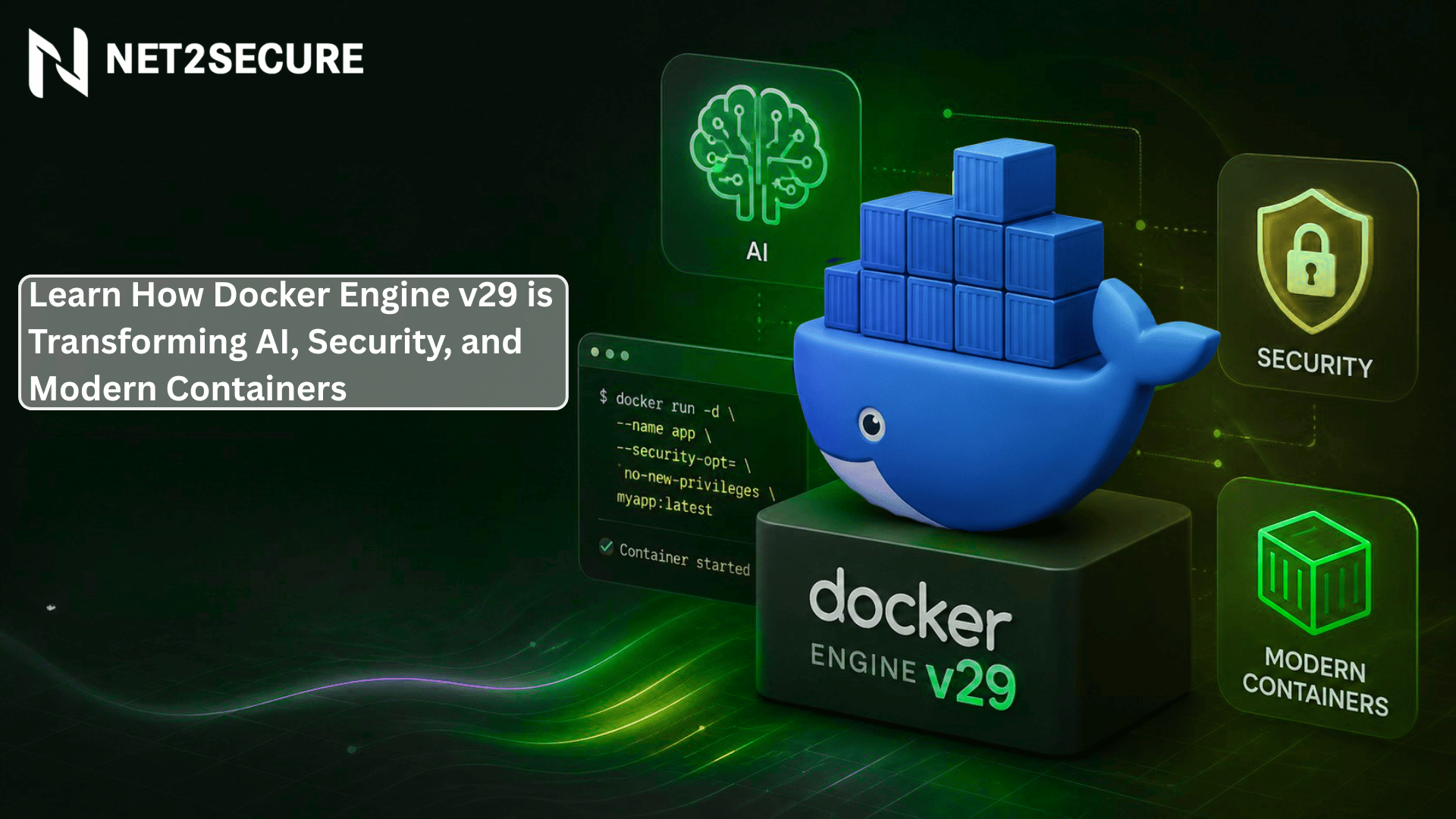
With the arrival of Docker Engine v29, the platform has entered a new era, driven by Agentic AI workflows, enterprise-grade supply chain security, intelligent automation, and foundational architectural upgrades designed for the future of cloud computing.
Currently, Docker is rapidly evolving from a developer tool into a prominent infrastructure ecosystem that fosters modern applications, AI agents, DevSecOps pipelines, and enterprise cloud environments at scale.
In this blog post, you will learn Docker in detail, understand its architecture, and the current Docker Engine v29. So, let’s get started.
What is Docker?
The term Docker refers to an open-source platform that enables developers and systems administrators to package applications into containers. Those containers can then be pushed onto a deployment platform, such as on-premises servers or servers in the cloud, and then executed directly. You can run several Docker containers, each with its own application, on an individual server, and those applications will be isolated from one another, delivering data security and reliability. The flexibility to run Docker containers on any compatible server is one of the technology’s breakthroughs.
Docker containers are used for business-critical, large-scale deployments consisting of a number of containers and servers. Inspired by the fundamental concept of containerization, Docker brought a fresh and pragmatic approach to application deployment. It uplifts containerization to new heights by introducing a set of features.
How does Docker work?
Docker works by using containerization technology to package an application along with everything it requires to run. It includes source codes, libraries, dependencies, and system tools. Rather, depending on the underlying operating system configuration, Docker creates lightweight, isolated environments known as containers that can operate effortlessly across different platforms and infrastructures.
At its core, Docker facilitates the entire application lifecycle through a streamlined process often described as:
Build<> Ship <> Run
The Build Phase
The Docker workflow starts with creating a Docker image. A Docker image is a lightweight executable package that contains everything needed to operate an application. Developers define these instructions inside a file, which is called a Dockerfile.
A Dockerfile contains commands that tell Docker:
-
Which operating system or base image to use
-
What dependencies are required to be installed
-
Which application files should be copied
-
Which commands should execute during startup
The Ship Phase
After building the image, it can be stored and allocated through a container registry such as Docker Hub or a private enterprise registry. It makes application deployment significantly easier because teams no longer need to configure servers or manually install dependencies. Instead, the complete application environment travels together as a single package.
Containers vs Virtual Machines
Containers and virtual machines both assist in running applications in isolated environments, but they work differently. Virtual machines depend on a hypervisor and include a complete guest operating system, which makes them heavier, slower to boot, and more resource-intensive.
Containers, on the other hand, share the host OS kernel and package only the application along with its required dependencies, making them lightweight, faster, and highly effective. While VMs deliver solid isolation for running various OS on an individual server, containers are designed for speed, portability, scalability, and modern cloud-native application development.
This is why technologies like Docker have become the preferred choice for DevOps, microservices, AI workloads, and large-scale cloud infrastructure in 2026.
What’s New in Docker Engine v29?
Docker Engine v29 acts as one of the most significant architectural upgrades in Docker’s evolution, shifting the platform far beyond traditional containerization. With current enterprises increasingly embracing Agentic AI, automated DevSecOps workflows, and multi-cloud deployments, Docker Engine v29 represents several improvements focused on performance optimization, intelligent automation, enterprise security, and scalable infrastructure management.
The recent release improves container runtime efficiency, lessens deployment overhead, and increases resource utilization, enabling organizations to run large-scale workloads more effectively across allocated environments.
One of the major notable breakthroughs in Docker Engine v29 is its solid focus on software supply chain security. As cyber threats targeting containerized applications continue to rise, Docker has integrated boost image verification, vulnerability scanning, secure dependency management, and improved runtime isolation capabilities.
These updates assist organizations in securing their applications throughout the entire development lifecycle, from image creation to production deployment. Docker primarily focuses on DevSecOps practices, which also allows development and security teams to work together more efficiently while handling compliance and infrastructure integrity.
Docker Engine v29 also presents improvements designed specifically for modern AI and machine learning environments. AI agents and autonomous workflows are becoming significantly more common in 2026. Docker now delivers more optimized support for isolated AI workloads, scalable model deployment, and containerized inference pipelines. Organizations can effectively package and deploy AI applications with better consistency, portability, and operational control.
Final Thoughts
Docker has covered a long way from being a normal containerization platform to becoming one of the most powerful technologies. With the introduction of Docker Engine v29 is no longer just helping developers package applications into containers. Instead, it is actively altering how organizations build, secure, deploy, and handle intelligent applications across allocated environments.
As business fastly embrace microservices, Kubernetes, hybrid cloud environments, and Agentic AI technologies, Docker’s flexibility, portability, and operational efficiency make it a crucial foundation for future infrastructure. Whether you are a startup building scalable applications or an enterprise managing complex workloads, Docker offers the speed, consistency, and reliability needed to thrive.
In the upcoming years, Docker is expected to rise even further alongside AI automation, edge computing, intelligent orchestration, and cloud-native innovation. Organizations that accept Docker today are not simply adopting a container platform: they are preparing their infrastructure for the next generation of intelligent, secure, and highly scalable computing.




.png)