

CCTV cameras are no longer used only to monitor what is happening in real time. For homes, offices, retail stores, warehouses, factories, hospitals and multi-location businesses, recorded CCTV footage can become important evidence when a security incident occurs. The question is: where should all that video footage be stored?
Traditionally, CCTV footage has been saved locally on a DVR, NVR or surveillance hard drive. Cloud storage provides another option by allowing footage to be stored on remote infrastructure and accessed through an internet connection.
This has led to an increasingly important question for Indian businesses: What is the CCTV cloud storage price in India?
There is no single price that applies to every CCTV installation. The cost depends on the number of cameras, video bitrate, resolution, recording duration, retention period, compression technology, storage capacity, bandwidth requirements and additional services.
As a general market reference, basic CCTV cloud recording in India may start at a few hundred rupees per camera per month, while business and enterprise implementations can cost substantially more. Instead of choosing a provider based only on the lowest advertised monthly price, businesses should calculate how much footage they generate and how long they need to retain it.
This guide explains how CCTV cloud storage pricing works, what affects the final cost, how much storage your cameras may require and how to estimate the right cloud infrastructure for your surveillance system.
Key Takeaways: CCTV Cloud Storage Price in India
- CCTV cloud storage prices in India vary widely depending on the number of cameras, video resolution, bitrate, recording method, retention period and cloud infrastructure required.
- As an indicative market range, basic CCTV cloud recording may start around ₹150–₹400 per camera per month, while longer-retention or advanced plans may cost approximately ₹500–₹1,500+ per camera per month.
- There is no universal per-camera price. Enterprise and multi-location CCTV deployments may instead be calculated according to storage, cloud server resources, bandwidth, backup and management requirements.
- A CCTV camera continuously recording at an average bitrate of 1 Mbps generates approximately 10.8 GB per day, or around 324 GB over 30 days.
- A camera continuously recording at 2 Mbps can require approximately 648 GB for 30 days. Four cameras at the same bitrate could require approximately 2.59 TB.
- Retention period has a major impact on storage requirements. Keeping footage for 90 days can require approximately three times the storage needed for 30 days when all other settings remain unchanged.
- Motion or event-based recording can reduce storage consumption compared with continuous 24/7 recording, particularly in areas with limited activity.
- Using H.265/HEVC compression where supported may reduce storage and bandwidth requirements, although actual savings vary according to the camera and video environment.
- Internet upload bandwidth is important. Multiple cameras continuously sending footage to the cloud can require substantial upstream network capacity.
- Hybrid CCTV storage, combining an on-site NVR with off-site cloud backup, can provide a practical balance between local recording, remote accessibility, redundancy and cost.
- Before requesting a CCTV cloud storage quote, businesses should know their camera count, resolution, average bitrate, recording type and required retention period.
- Businesses should compare the total storage architecture and cost rather than selecting a provider solely because it advertises the cheapest per-camera price.
Quick Answer: How Much Does CCTV Cloud Storage Cost in India?
Quick Answer: For basic cloud CCTV services in India, indicative pricing may begin at approximately ₹150–₹400 per camera per month, particularly for shorter retention periods or motion-based recording. Plans with longer retention, higher video quality, advanced management or additional services can reach approximately ₹500–₹1,500+ per camera per month.
These figures should be treated as indicative market ranges rather than fixed quotations. Actual prices can differ substantially depending on the service provider and technical configuration.
A business with four cameras, for example, might spend anywhere from approximately ₹600 per month for a basic setup to several thousand rupees per month for longer retention or advanced functionality.
Enterprise CCTV storage is different. Businesses operating dozens or hundreds of cameras may use dedicated cloud servers, object storage, private cloud infrastructure or hybrid CCTV architectures rather than purchasing a standard consumer-style per-camera subscription.
In these environments, pricing is usually calculated according to actual infrastructure requirements.
What Is CCTV Cloud Storage?
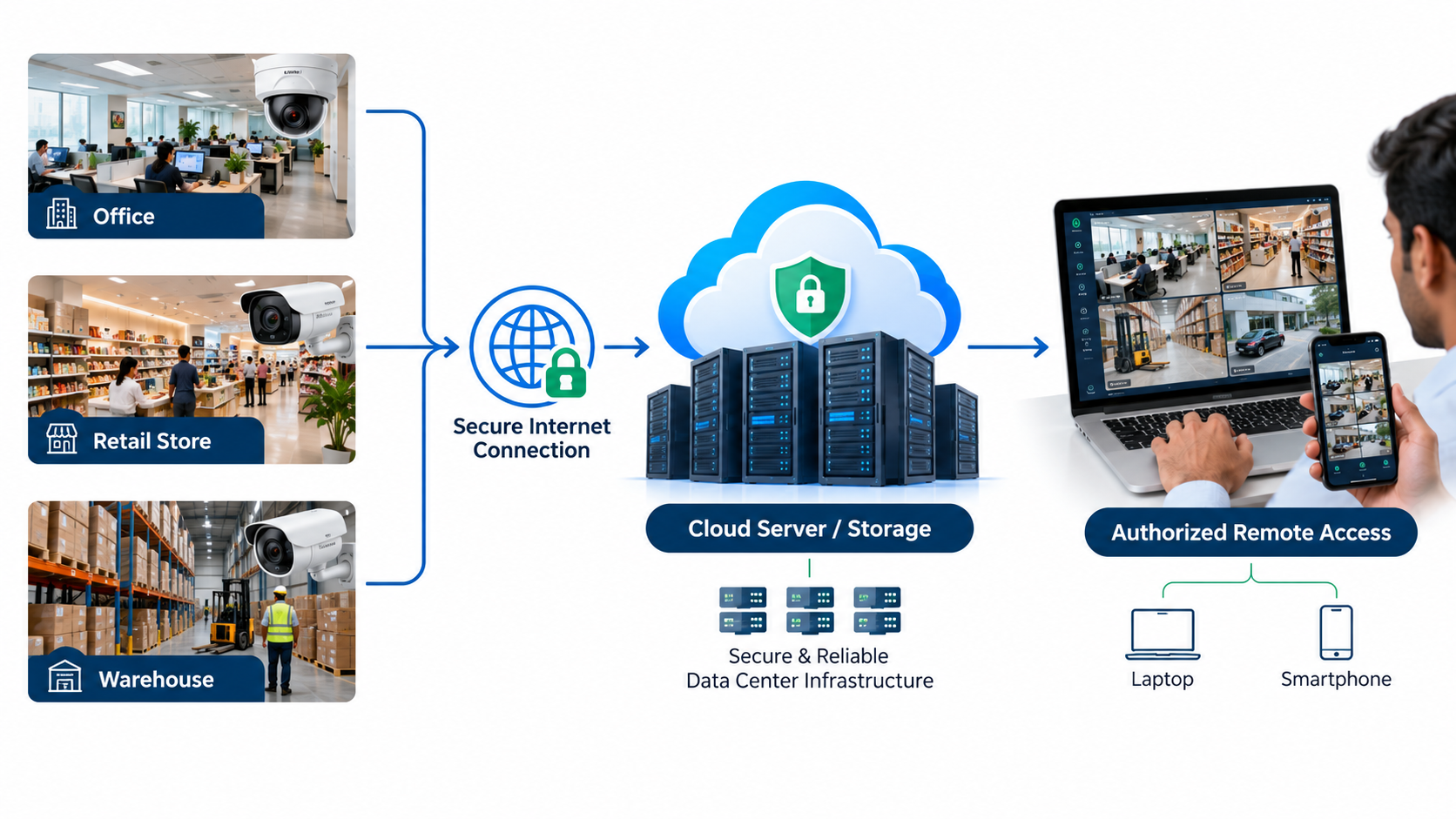
CCTV cloud storage is a system in which surveillance footage is transmitted through a network and stored on remote server or cloud infrastructure rather than being retained exclusively on a DVR, NVR, SD card or hard drive installed at the monitored location.
Depending on the architecture, footage may be uploaded continuously, uploaded only when motion or another event is detected, or copied from an existing local recording system as a secondary backup.
Authorized users can then access the stored footage remotely using a web portal, application, VMS or another supported interface.
Cloud storage can be particularly useful when the physical recording equipment at the site is damaged, fails or is compromised during an incident. However, whether it should completely replace local recording depends on the organization's security, connectivity, retention and recovery requirements.
For many businesses, a hybrid CCTV storage strategy combining local recording with off-site cloud backup can provide a useful balance.
CCTV Cloud Storage Price in India: Estimated 2026 Range
| CCTV Cloud Storage Type | Indicative Price Range | Typical Use |
|---|---|---|
| Basic Cloud Recording | ₹150–₹400/camera/month | Homes and small shops |
| Standard Business Recording | ₹350–₹800/camera/month | Offices, retail stores and SMBs |
| Extended-Retention Cloud Storage | ₹800–₹1,500+/camera/month | Businesses requiring longer footage retention |
| Dedicated Cloud CCTV Server | Custom Pricing | Medium and large businesses |
| Hybrid Local + Cloud Storage | Custom Pricing | Businesses requiring local recording and off-site backup |
| Multi-Location Enterprise CCTV | Custom Pricing | Retail chains, warehouses, factories and distributed businesses |
Important: These prices are indicative market ranges rather than a fixed Net2Secure quotation. Actual CCTV cloud storage pricing depends on storage consumption, retention, bandwidth, infrastructure, software, support, redundancy and other technical requirements.
Why Is There No Fixed CCTV Cloud Storage Price?
Two businesses may both operate ten CCTV cameras and still have dramatically different storage requirements.
Consider one shop recording ten 1080p cameras only when motion is detected and retaining footage for seven days. Compare that with a warehouse recording ten 4K cameras continuously for 90 days.
Both have ten cameras, but their storage consumption is completely different.
This is why camera count alone is not enough to calculate CCTV cloud storage costs. A reliable estimate should consider the number of cameras, camera resolution, bitrate, video compression, recording method and retention period.
1. Number of CCTV Cameras
The number of cameras is one of the most obvious cost factors. If your provider charges per camera, adding more cameras directly increases the subscription. If your CCTV system uses storage-based cloud infrastructure, additional cameras increase the total amount of video generated and therefore increase storage and bandwidth requirements.
A four-camera shop will generally require considerably less cloud infrastructure than a factory operating 100 cameras across multiple locations.
2. Camera Resolution
Higher-resolution CCTV footage generally requires more data. A 1080p camera usually generates less video data than a 4MP or 4K camera when other settings are comparable.
Higher resolution can provide additional detail, but storing every camera at maximum resolution for long periods may increase cloud storage consumption considerably.
Organizations should therefore determine which locations genuinely require high-resolution recording. Entrances, cash counters or critical operational areas may need greater image detail than low-risk corridors.
3. Video Bitrate
Bitrate is one of the most important factors in CCTV storage calculation. It represents the amount of video data transmitted over a period of time and is generally expressed in Mbps.
Higher Bitrate = More Video Data = More Storage Required
For continuous recording, 1 Mbps produces approximately 10.8 GB of data per day using decimal storage units.
Therefore, a camera continuously recording at 2 Mbps would generate approximately 21.6 GB per day before additional overhead or other considerations.
Actual CCTV bitrates vary according to camera settings, resolution, frame rate, codec, scene complexity and manufacturer implementation.
4. H.264 vs H.265 Compression
Video compression can have a significant effect on cheap CCTV cloud storage requirements. H.264 remains widely supported, while H.265/HEVC is designed to provide more efficient compression.
When compatible cameras and recording platforms are available, H.265 can reduce the storage and bandwidth required to maintain comparable video quality.
However, businesses should not assume a universal percentage saving. Actual results depend on camera configuration, movement within the scene, lighting and implementation.
5. CCTV Retention Period
Retention refers to how long recorded CCTV footage remains available. Common configurations include 7, 15, 30, 60 and 90 days, while some organizations may require footage for 180 days or longer.
| Retention Period | Typical Application | Storage Impact |
|---|---|---|
| 7 Days | Basic monitoring and small installations | Low |
| 15 Days | Small businesses and offices | Low to Medium |
| 30 Days | General business surveillance | Medium |
| 60–90 Days | Businesses needing longer investigation windows | High |
| 180+ Days | Special operational or compliance requirements | Very High |
If all other settings remain unchanged, moving from 30-day to 90-day retention can require approximately three times as much storage.
Before choosing a retention period, businesses should also check contractual, sector-specific and applicable regulatory requirements.
6. Continuous vs Motion-Based Recording
A CCTV camera does not necessarily need to upload video 24 hours a day.
With 24/7 continuous recording, footage is captured throughout the day. This provides a complete timeline but consumes significantly more storage and network bandwidth.
With motion or event-based recording, footage is recorded or uploaded when specified activity is detected. This can substantially reduce storage consumption in low-activity environments.
However, motion recording is not suitable for every use case. Critical areas may require uninterrupted recording. Some businesses therefore use a combination of both methods.
How Much CCTV Cloud Storage Do You Need?
A practical CCTV storage estimate can be calculated from the camera bitrate.
Storage = Number of Cameras × Bitrate × Recording Time × Retention Period
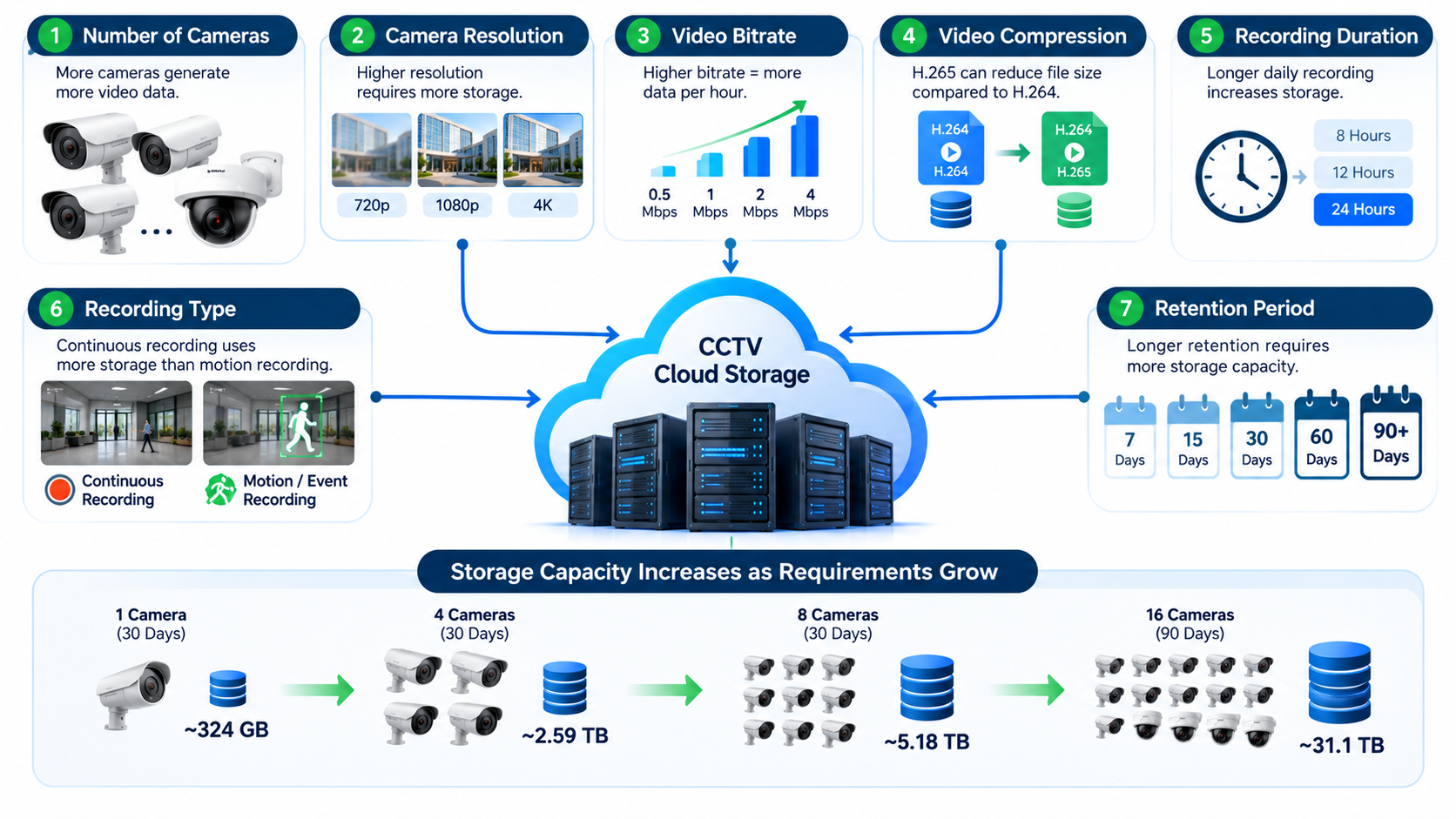
For decimal units, one camera recording continuously at 1 Mbps generates approximately 10.8 GB per day.
| Average Bitrate | Approx. Data per Camera/Day | Approx. 30-Day Storage |
|---|---|---|
| 0.5 Mbps | 5.4 GB | 162 GB |
| 1 Mbps | 10.8 GB | 324 GB |
| 2 Mbps | 21.6 GB | 648 GB |
| 4 Mbps | 43.2 GB | 1.30 TB |
| 8 Mbps | 86.4 GB | 2.59 TB |
These calculations assume continuous recording and decimal storage units. They are planning estimates, not guarantees of actual CCTV consumption. Real storage requirements can vary according to codec, frame rate, scene activity, variable bitrate settings, camera implementation and recording schedules.
CCTV Cloud Storage Calculation Example
Suppose a business operates 8 CCTV cameras, each with an average bitrate of 2 Mbps, recording continuously with a 30-day retention period.
At 2 Mbps, one camera generates approximately:
21.6 GB/day
For eight cameras:
21.6 GB × 8 = 172.8 GB/day
For 30 days:
172.8 GB × 30 = 5,184 GB ≈ 5.18 TB
Therefore, the raw footage requirement is approximately 5.18 TB. A production deployment should generally include additional capacity for operational overhead, growth and variations in actual bitrate.
How Much Storage Would 4 CCTV Cameras Require?
Consider four cameras averaging 2 Mbps with continuous recording.
| Retention Period | Approx. Storage for 4 Cameras |
|---|---|
| 1 Day | 86.4 GB |
| 7 Days | 605 GB |
| 15 Days | 1.30 TB |
| 30 Days | 2.59 TB |
| 90 Days | 7.78 TB |
A relatively small four-camera system can therefore consume several terabytes when footage is recorded continuously for long periods. Motion-based recording could significantly reduce these figures depending on how frequently activity triggers recording.
CCTV Cloud Storage Price: Per Camera vs Storage-Based Pricing
Per-Camera Pricing
Under a per-camera model, the provider charges a monthly fee for each connected camera.
For example, if a hypothetical service costs ₹400 per camera per month, ten cameras would cost:
₹400 × 10 Cameras = ₹4,000/month
The advantage is predictable billing. However, the cost can increase quickly as additional cameras are installed. Organizations should check exactly what the per-camera price includes, particularly retention, resolution, download limits, support and bandwidth.
Infrastructure or Storage-Based Pricing
Larger deployments may be priced according to infrastructure consumption instead.
Storage Capacity + Cloud Compute + Data Transfer + Backup + Management + Software + Support
This approach can make more sense for businesses managing large CCTV environments or requiring custom retention policies.
CCTV Cloud Storage vs DVR/NVR: Which Is Better?
| Factor | DVR/NVR Storage | CCTV Cloud Storage |
|---|---|---|
| Initial Investment | Usually higher | Can be lower depending on architecture |
| Recurring Storage Cost | Relatively low | Monthly or annual recurring cost |
| Physical Hardware | Required | Reduced for cloud-only architectures |
| Remote Accessibility | Depends on configuration | Typically a core feature |
| Storage Expansion | Requires hardware upgrades | Generally more scalable |
| Off-Site Copy | Requires separate setup | Can be built into the architecture |
| Internet Dependency | Lower for local recording | Higher for cloud upload/access |
| Hardware Maintenance | Customer responsibility | Infrastructure layer handled by cloud provider |
| Multi-Location Management | Can become complex | Generally easier to centralize |
Neither approach is automatically better. Local NVR storage can be economical when large volumes of footage must be retained and remote redundancy is not essential.
Cloud storage can be attractive when organizations prioritize remote accessibility, off-site protection, centralized management and scalable capacity. For many organizations, hybrid CCTV storage can be the most practical architecture.
What Is Hybrid CCTV Cloud Storage?
Hybrid CCTV storage combines local recording with cloud-based storage or backup.
For example, cameras may record continuously to an on-site NVR while important footage, event clips or backup copies are transmitted to cloud infrastructure.
This architecture provides two storage layers. If internet connectivity is temporarily unavailable, the local recording system may continue to capture footage. At the same time, cloud storage provides an off-site copy of selected footage when connectivity is available.
Hybrid storage can be especially useful for offices, retail chains, warehouses and businesses where losing all surveillance footage because of a single hardware incident would create unacceptable risk.
Does Internet Speed Affect CCTV Cloud Storage?
Yes. Cloud CCTV is not only a storage problem; it is also a network bandwidth problem.
If multiple cameras continuously upload high-bitrate streams, the organization's internet connection must have sufficient upload bandwidth.
For example, eight cameras each uploading approximately 2 Mbps would theoretically require:
8 Cameras × 2 Mbps = Approximately 16 Mbps Upload Bandwidth
This calculation is before allowing for protocol overhead, other applications and capacity margin. Therefore, a business should evaluate both cloud storage capacity and internet upload capability before implementing continuous cloud recording.
How Can You Reduce CCTV Cloud Storage Costs?
The best way to reduce CCTV cloud storage expenditure is not simply to purchase the cheapest plan. It is to optimize the amount of video data being generated and retained.
Using efficient codecs such as H.265 where supported can reduce bandwidth and storage requirements. Motion or event-based recording can be considered for locations where continuous footage is unnecessary.
Retention policies should also be designed according to actual business requirements. There may be little value in paying for 90 days of cloud retention if the organization genuinely requires only 30 days.
Businesses can also assign different recording policies to different cameras. A critical entrance camera might require continuous high-quality recording, while a low-risk internal area might use motion recording. This type of tiered strategy can substantially improve storage efficiency.
Is Cheap CCTV Cloud Storage Always Better?
Not necessarily. A low advertised monthly price may look attractive, but businesses should check what is actually included.
Before purchasing CCTV cloud storage, check the footage retention period, supported resolution, recording type, upload or bandwidth limitations, footage export options, user access controls, encryption options, backup and redundancy, storage overage charges, technical support and any additional charges associated with downloads or additional users.
For business surveillance, the cheapest price is less important than understanding the complete storage architecture and total cost.
CCTV Cloud Storage for Small Businesses in India
Small businesses such as shops, clinics, restaurants and offices typically do not need an enterprise-scale surveillance platform.
A smaller environment might have four to eight cameras with seven, 15 or 30 days of retention. For such organizations, the key is to determine whether every camera requires continuous cloud recording.
A hybrid configuration or motion-based cloud backup may provide better cost efficiency while still protecting important footage.
CCTV Cloud Storage for Enterprises
Enterprise CCTV environments can involve dozens, hundreds or even thousands of cameras across multiple locations.
At this scale, simple per-camera consumer cloud hosting plans may not provide the flexibility required. Businesses may need dedicated compute resources, scalable storage, private networking, access controls, centralized monitoring, backup policies and custom retention periods.
For such deployments, the correct question becomes less about the advertised CCTV cloud storage price per camera and more about the total cost of the surveillance data architecture.
CCTV Cloud Storage with Net2Secure
Net2Secure can help businesses evaluate cloud infrastructure for CCTV footage storage based on their actual technical requirements rather than relying on a generic one-size-fits-all package.
The appropriate architecture depends on factors such as the number of CCTV cameras, average bitrate, recording resolution, daily recording duration, retention period, expected storage growth, bandwidth and whether the organization requires cloud-only or hybrid storage.
For businesses with larger surveillance environments, cloud server and scalable storage architectures can provide greater flexibility than a simple fixed-capacity local recording system.
Before deployment, the storage and network requirements should be calculated using the actual camera configuration wherever possible.
Information to Provide Before Requesting a CCTV Cloud Storage Quote
| Requirement | Information Needed |
|---|---|
| Number of Cameras | Total cameras requiring cloud storage |
| Resolution | 1080p, 4MP, 4K, etc. |
| Codec | H.264, H.265 or camera-specific compression |
| Average Bitrate | Mbps per camera where available |
| Recording Method | Continuous, scheduled, motion or event-based |
| Retention | 7, 15, 30, 60, 90+ days |
| Locations | Single or multiple sites |
| Current Recorder | DVR, NVR, VMS or direct IP cameras |
| Internet Connection | Available upload bandwidth |
| Storage Architecture | Cloud-only, backup or hybrid |
| Expected Growth | Additional cameras planned |
| Special Requirements | Access control, redundancy, backup, monitoring, etc. |
How to Choose CCTV Cloud Storage in India
The right CCTV cloud storage solution should balance cost, capacity, retention, performance, security and accessibility.
Start by calculating how much footage your cameras actually generate. Next, determine how long that footage needs to remain available. Then decide whether all footage needs to be stored in the cloud or whether a hybrid strategy would be more economical.
Finally, compare providers based on the complete service rather than the headline monthly price.
For business-critical surveillance, scalability should also be considered. A system designed for eight cameras today may need to support 20 or 50 cameras in the future.
Frequently Asked Questions About CCTV Cloud Storage Price in India
What is the CCTV cloud storage price in India?
Basic CCTV cloud recording services in India may start at approximately ₹150–₹400 per camera per month, while plans with longer retention or additional functionality can cost ₹500–₹1,500 or more per camera per month. Enterprise deployments are commonly priced according to infrastructure and storage requirements. These are indicative market ranges rather than fixed quotations.
How much does CCTV cloud storage cost per month?
Monthly CCTV cloud storage cost depends on camera count, bitrate, resolution, recording method and retention. A four-camera installation can cost considerably less than an enterprise deployment with dozens of continuously recording cameras.
How much storage does one CCTV camera need for 30 days?
A camera averaging 2 Mbps and recording continuously generates approximately 21.6 GB per day, or about 648 GB over 30 days using decimal units. A 4 Mbps stream would require approximately 1.3 TB for the same period. Actual consumption can vary.
How much storage do four CCTV cameras need?
Four cameras averaging 2 Mbps and recording continuously would generate approximately 86.4 GB per day. Over 30 days, this equals approximately 2.59 TB before allowing for operational overhead or additional capacity.
Is CCTV cloud storage better than an NVR?
Neither is universally better. NVR storage provides local recording and can reduce recurring cloud costs, while cloud storage offers off-site storage, scalability and remote accessibility. A hybrid architecture can combine the advantages of both.
Can existing CCTV cameras use cloud storage?
In many cases, existing IP cameras, NVRs or VMS environments can be integrated with cloud infrastructure, but compatibility depends on camera protocols, recorder capabilities, network configuration and the selected cloud architecture.
Does CCTV cloud storage require high-speed internet?
Cloud recording requires sufficient upload bandwidth. Continuous high-resolution recording from multiple cameras can consume significant bandwidth. Network capacity should therefore be calculated before deployment.
Is 1 TB enough for CCTV storage?
It depends on bitrate, number of cameras and retention. At a continuous 2 Mbps bitrate, a single camera can generate roughly 648 GB over 30 days. Therefore, 1 TB might support one such camera for approximately a month with some capacity remaining, but it would not be sufficient for multiple cameras under the same recording settings.
Can CCTV footage be stored in the cloud without a DVR?
Yes. Certain IP-camera and cloud architectures can send footage directly to remote infrastructure without relying on a traditional DVR. However, the exact setup depends on camera compatibility, network design and recording software.
What is the cheapest way to store CCTV footage in the cloud?
Cost can often be reduced by using H.265 compression where supported, optimizing bitrate and frame rate, using motion/event recording where appropriate, setting realistic retention periods and adopting a hybrid local-plus-cloud strategy instead of continuously uploading every camera at maximum quality.
Final Thoughts
There is no universal answer to the question “What is the CCTV cloud storage price in India?”
A small installation with a few motion-recording cameras may require relatively little storage, while a multi-location organization recording dozens of high-resolution cameras continuously can generate terabytes of footage every month.
Camera Count → Bitrate → Recording Duration → Retention → Total Storage → Bandwidth → Cloud Architecture
Once these factors are known, businesses can compare CCTV cloud storage solutions on a like-for-like basis instead of choosing a plan solely because it advertises a low monthly price.
For organizations considering cloud-based or hybrid CCTV storage, Net2Secure can help evaluate infrastructure requirements according to camera count, expected storage consumption, retention period and scalability requirements.
Need an Estimate for Your CCTV Cloud Storage Requirement?
Share your number of cameras, camera resolution, average bitrate and required retention period with Net2Secure to calculate the approximate cloud storage capacity your CCTV environment may require.
Technical Disclaimer: Storage calculations in this guide are planning estimates. Actual consumption varies according to bitrate configuration, codec, frame rate, scene complexity, motion, recording schedule and camera implementation. Pricing ranges are indicative and should not be interpreted as a fixed Net2Secure quotation.