Understanding DDoS Attacks: How They Work and How to Prevent Them
 Written By
Anurag Soam
Published On
July 28, 2026
Reading Time
4 minutes
Written By
Anurag Soam
Published On
July 28, 2026
Reading Time
4 minutes
 Review By
Net2secure Tech Team
Review By
Net2secure Tech Team
A distributed denial-of-service (DDoS) attack is one of the most common cyber threats that can affect websites, applications, and online services by overwhelming them with ample amounts of fake traffic. These attacks can slow down or fully shut down a service, leading to downtime, revenue loss, and a poor user experience.
Simply put, you can understand that a DDoS attack is an illegal attempt to make a website unavailable by overloading its server with excessive amounts of fake traffic. The onslaught of malicious connection requests pushes legitimate visitors to the back of a diminishing traffic queue, preventing the website from loading.
In this post, you will learn what a DDoS attack is, how it works, and the best ways to secure your systems from these attacks.
How Does a DDoS Attack Work?
A DDoS attack works by flooding a website, a server, or an online application with an enormous amount of fake internet traffic. Instead of using a single computer, attackers prefer thousands or even millions of compromised devices, known as a botnet, to send requests to the same target at the same time. These devices can consist of computers, smartphones, routers, and IoT devices that have been infected with malware and are controlled remotely by the attacker.
When the botnet begins sending an overwhelming number of requests, the target server attempts to process every request. As the server’s CPU, memory, bandwidth, or network resources become exhausted, it can no longer respond to legitimate users. This results in slow website performance, service interruptions, or complete downtime.
The attack mainly follows these steps:
-
Compromise Devices: Attackers infect vulnerable computers and IoT devices with malware.
-
Create a Botnet: The infected devices are connected into a network that can be controlled remotely.
-
Launch the Attack: The attacker instructs the botnet to send a massive number of requests to the target.
-
Overload the Server:The flood of fake traffic consumes the server's resources.
-
Service Disruption:Genuine users are unable to access the website or application because the server is overwhelmed.
Difference between a DoS attack and a DDoS attack
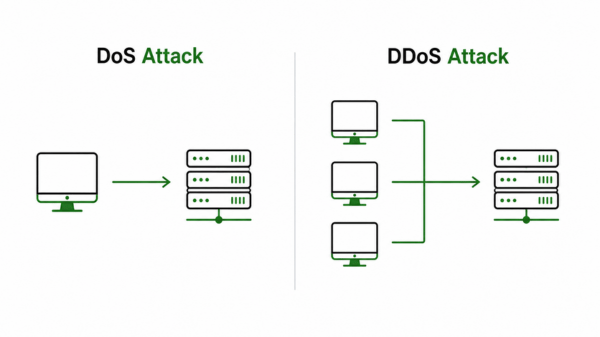
A DoS attack derives from a single compromised device that sends malicious requests to overwhelm a target. In contrast, a DDoS attack uses several compromised devices, known as a botnet, to flood the target with a much larger volume of malicious traffic.
Types of DDoS Attacks
All DDoS attacks have an objective to overload online resources to the point of being unresponsive. There are three primary categories of DDoS attacks:
-
Volume-Based DDoS Attacks
-
Protocol or Network-Layer DDoS Attacks
-
Application Layer-Attacks
How to Prevent a DDoS Attack?
Preventing DDoS attacks can be challenging during periods of high traffic or within large, distributed network environments. An effective proactive DDoS defense strategy depends on three main pillars:
-
Minimizing the attack surface
-
Regularly monitoring for threats
-
Deploying scalable DDoS mitigation solutions
Methods to Prevent DDoS Attacks
-
Attack Surface Reduction: Limiting attack surface exposure can assist in minimizing the effect of a DDoS attack. Various methods for decreasing this exposure include restricting traffic to specific locations, implementing a load balancer, and blocking communication from outdated or unused ports.
-
Anycast Network Diffusion: An Anycast network assists in increasing the surface area of an organization’s network. So that it can more easily absorb volumetric traffic spikes by dispersing traffic across various distributed servers.
-
Real-time, Adaptive Threat Monitoring: Log monitoring can help pinpoint potential threats by analyzing network traffic patterns, controlling traffic spikes or other unusual activity.
Thus, DDoS attacks continue to be one of the most persistent cybersecurity threats, capable of affecting websites, applications, and online services by overwhelming them with malicious traffic. As these attacks become more frequent, organizations must adopt a proactive security strategy rather than depending on reactive measures.
By understanding how DDoS attacks work, identifying the different attack types, and implementing crucial measures such as attack surface reduction and continuous threat monitoring. Anycast networking and scalable DDoS mitigation solutions, businesses can decrease the risk of service disruptions. A layered defense approach, combined with regular monitoring and preparedness, assists in ensuring high availability, securing critical infrastructure, and offering an effortless experience for legitimate users even during attempted attacks.
By Anurag Soam
A skilled Technical Content Writer with an unwavering dedication to covering complex concepts and specializing in writing explicit, concise, and SEO-friendly content for diverse audiences. With a solid background in technology, including SaaS, PaaS, IaaS, Documentation, Cloud, Cybersecurity, and DevOps, he’s an expert in curating content that enhances user experience and facilitates product success. He’s constantly updated on the latest industry trends and tools to deliver qualitative technical content.
View all of Anurag Soam's posts.